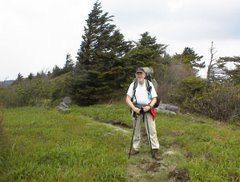
Well two very nice people visited my blog and said kind things. So I am renewed and reinvigorated and ready to post more stuff. Herewith is an:
Impromptu Poem
Light has faded, the shadows stretch
across the leaf strewn yard
and across that hill yonder
the Blue Ridge rises,
giants of old,
their haze creating an impressionist
covering for the crags and the blue spruce
dressing them like brides of the morning.
And I turn to my screen
and try to tell you, dear friend,
that life resides in the dew of that moment
when the heart is open to the beauty
the world lavishes on us between acts of savage fury
and life is lived in the margins amid the folds of the mind
on an afternoon when sunlight washes
the leaves and the crows lumber
across the sky and you breathe
the precious air and cling tightly to
almighty hope.
Friday, June 29, 2007


Wednesday, June 27, 2007
The Sound of a Tree Falling...
Well, I guess the question is answered. There IS nobody out there. It has been over a week since I asked that apparently rhetorical question and still no comments. I wonder how many blogs are on Blogger. Probably millions, 95% of which are read only by friends and family. Ces la vies or whatever the heck it is that those benighted Frenchies say.
I am wasting my time...or am I? If someone eventually reads this, then the time will not have been wasted. If no one reads this but I get something off my chest, the time will not have been wasted. Either way, I am a winner. Now, I feel much better!
I am wasting my time...or am I? If someone eventually reads this, then the time will not have been wasted. If no one reads this but I get something off my chest, the time will not have been wasted. Either way, I am a winner. Now, I feel much better!
Tuesday, June 19, 2007
Is ANYBODY out there?
Well it has been a few weeks now that this remarkable little web log has been up and running and guess what; there have been -0-, nada, zilch, bupkus comments!
Are you out there dear reader, somewhere on that vast information highway, trudging through blogs about dogs and blogs about nothing? Am I too old and quaint for your taste?
I know most of you are young and probably much too hip (do they still use that word?) for me.
Well here's some news...I saw Jimi Hendrix live in 1969. How about that? That ain't all...I have seen The Who, Led Zeppelin, Iron Butterfly, Grand Funk Railroad, Santana, Chicago, and many others live in the late sixties. Still think I'm not cool?
Oh well, I probably became not cool somewhere north of thirty years ago. My question still rings across the vastness of the world wide web like the squeak of a mouse across the Grand Canyon.
Is anybody out there?
Are you out there dear reader, somewhere on that vast information highway, trudging through blogs about dogs and blogs about nothing? Am I too old and quaint for your taste?
I know most of you are young and probably much too hip (do they still use that word?) for me.
Well here's some news...I saw Jimi Hendrix live in 1969. How about that? That ain't all...I have seen The Who, Led Zeppelin, Iron Butterfly, Grand Funk Railroad, Santana, Chicago, and many others live in the late sixties. Still think I'm not cool?
Oh well, I probably became not cool somewhere north of thirty years ago. My question still rings across the vastness of the world wide web like the squeak of a mouse across the Grand Canyon.
Is anybody out there?
Tuesday, June 5, 2007
General Musings
This is dangerous. I am writing this as I post or posting this as I write, unsure which is correct.
I worry for America. We seem to have lost not only our morality and conscience, but our cohesion as a people. Not to overplay it, but I remember an America of the fifties and early sixties where most of us danced to the same beat, or at least condescended to each other's beat.
I was just on an AOL blog about Obama's reckless statements about blacks and a "quiet riot." The talk was mostly hateful, to a large degree banal and of an ignorant bent.
The blacks were shouting (rhetorically speaking) at the whites and the whites were shouting at the blacks, dredging up all the old racial stereotypes. They were like children furiously screaming at each other on the playground, spittle flying, faces red. It was discouraging to say the least.
After all these years, we are still at the point where the slightest thing brings out the racist in many of us. I grew up in a racist environment, where blacks were viewed as third class citizens at best. I never attended school with a black person until I was in college (definitely dates me). And I must confess when I see certain behaviors my knee jerk reaction is to attribute it to race, then I always think of an example just as deplorable in my own race, and I seem to gain a level of perspective about it.
Somehow, someway, we have to get beyond all that. We all have to take responsibility for our own actions, something I believe more whites than blacks believe in. However, whites have no exclusivity to responsible behavior and blacks are certainly not predominantly irresponsible. In any case, a little humility and some simple humanity will go a long way toward healing and reconciliation. Jesus Christ had it right. Too bad the vast majority of us pay no more than lip service to his teaching.
I worry for America. We seem to have lost not only our morality and conscience, but our cohesion as a people. Not to overplay it, but I remember an America of the fifties and early sixties where most of us danced to the same beat, or at least condescended to each other's beat.
I was just on an AOL blog about Obama's reckless statements about blacks and a "quiet riot." The talk was mostly hateful, to a large degree banal and of an ignorant bent.
The blacks were shouting (rhetorically speaking) at the whites and the whites were shouting at the blacks, dredging up all the old racial stereotypes. They were like children furiously screaming at each other on the playground, spittle flying, faces red. It was discouraging to say the least.
After all these years, we are still at the point where the slightest thing brings out the racist in many of us. I grew up in a racist environment, where blacks were viewed as third class citizens at best. I never attended school with a black person until I was in college (definitely dates me). And I must confess when I see certain behaviors my knee jerk reaction is to attribute it to race, then I always think of an example just as deplorable in my own race, and I seem to gain a level of perspective about it.
Somehow, someway, we have to get beyond all that. We all have to take responsibility for our own actions, something I believe more whites than blacks believe in. However, whites have no exclusivity to responsible behavior and blacks are certainly not predominantly irresponsible. In any case, a little humility and some simple humanity will go a long way toward healing and reconciliation. Jesus Christ had it right. Too bad the vast majority of us pay no more than lip service to his teaching.
Thursday, May 24, 2007
Scarecrow in Gray, the First Chapter, by Barry Yelton
Scarecrow in Gray
Copyright 2005
By Barry D. Yelton
CHAPTER ONE
A soldier who fights
in a war not his own,
bears the burden
of manifold tragedy.
I am not a soldier. I have been a farmer for most of my thirty-one years. I come from the hills of western North Carolina, from a county called Rutherford, a land of hills and hollows. It is a place where the evening mist tints the ridges blue as they roll toward the far horizon, each layer of hills becoming ever lighter in hue until the sky appears to be joined to the land. The ancient mountains and lush river valleys pulse with life planted by God and watered by the very lifeblood of my forebears. Since before the Revolution our family has lived here, farmed the land, and left our earthly remains in this good soil.
Copyright 2005
By Barry D. Yelton
CHAPTER ONE
A soldier who fights
in a war not his own,
bears the burden
of manifold tragedy.
I am not a soldier. I have been a farmer for most of my thirty-one years. I come from the hills of western North Carolina, from a county called Rutherford, a land of hills and hollows. It is a place where the evening mist tints the ridges blue as they roll toward the far horizon, each layer of hills becoming ever lighter in hue until the sky appears to be joined to the land. The ancient mountains and lush river valleys pulse with life planted by God and watered by the very lifeblood of my forebears. Since before the Revolution our family has lived here, farmed the land, and left our earthly remains in this good soil.
I confess that I did begin thinking about joining the Southern Army shortly after the war began, but I had a family and there was no one else to provide for them. My brothers had their own families to look after and some of them had already made their plans to go to war. Foolish plans they were in a foolish time.
As strange as it may seem now, in the beginning many thought it a great adventure, lots of fun marching, and parading and shooting at Yankees. I think most learned pretty quick that the fun is mighty scarce on a battlefield. I never had any illusions about that.
I am a fair hand with a musket. I hunt a little, mostly deer, rabbits and ‘coons, sometimes bear. I never shot at a man before the war. That’s an entirely different matter than hunting game. You shoot a deer and look in that black shining eye and you can see there’s nothing there but flesh and blood. You look into the eyes of your fellow man, no matter how debased he may be, and you know there is a soul, a being of a higher order, not just an animal.
I thought about this a lot before I went to war and it kept me from marching off to join I must tell you, along with the fact that I had my family to feed. I couldn’t grow crops in Camp Creek from an army post in Virginia or Tennessee. And even if I went, could I really bring myself to kill my fellow man? Would I have the courage to fight and to die? These questions burned in my mind as I watched men leave, go to war, and die. Those who did manage to come home were often maimed or scarred so badly, the folks at home treated them like pariahs. They were damaged people who often could no longer work. The presumption was that somehow they did something wrong to get shot or lose a leg or an arm or an eye. I wondered if I could deal with that if it were my lot.
Anyhow, I never owned any slaves, none of our family did. We often jested about how we worked like slaves ourselves, we just didn’t have any master to feed and clothe us. All we had was what we could grow on a few acres, which were sharecropped, or bought on credit from some parsimonious banker or maybe purchased from a hard up farmer who needed money more than land.
Where I come from, we don’t take freedom lightly. Mountain folks have always been of freedom loving, independent mind. Our people fought like demons against the British and Tories in our War for Independence. My grandfather, James Yelton, was one of those who pledged his all to fight for our new country.
I suppose that hill country folks’ love of independence came from having to rely on your own wit and will to survive when money was scarce and life was hard. When winter howled into the hill country and hunger sniffed at your door like a bear out of hibernation, you had to be strong of will and body just to survive. Heeling and toeing to a tyrant was never something we cottoned to whether it was a British tyrant or an American one. We bowed to neither foreign kings nor slaveholders from down east. We always went our own way, paying allegiance only to God Almighty. We believed that if you settled for anything other than freedom you might as well be a dumb animal.
Our folks had no quarrel with the Yankees about whether whites could own slaves or not. What reason did I have to go off to Virginia or somewhere and shoot at men with whom I had no quarrel? The recruiters sometimes came around telling me I needed to do my patriotic duty and I told them I was, by growing crops to feed my family and others. I sold what I could to the Confederate quartermasters and the home guards and I trust it went to help feed the soldiers fighting in Virginia, as well as those hometown heroes whose primary combatants were colored bottles on fence posts. They paid me in Confederate script in amounts which seemed large at the time, but when I went to buy something, I found I had sold too cheap. It seemed to me it would take a wheel barrow full of Confederate script to buy a shoat. It also seemed to me like I was doing my duty and then some, working my body into old age and selling my produce to the government for a song.
I served for a while as a lieutenant with the North Carolina Militia, but then folks began to accuse me of dodging the war. I pondered joining the regular army because I did not want my reputation to suffer by being considered a dodger. Fact was the recruiters were always preaching that General Robert E. Lee needed men like me; that the Yankees were coming in hordes. I usually replied that if the Yankees were coming in hordes one more farmer with a musket wasn’t going to make much difference, but I might try my hand anyway if it upheld my good name to do so.
Things came to a head one Friday morning in late July of ‘64 when I was in the bottom plowing weeds and early crops under. I got up about four thirty because daylight comes early in July and I wanted to get the bottom plowed, so I could move on to the west slope. I walked out to the barn to get “Moses.” That’s what I called the old black mule I bought from Silas Freeman over by Gilbert Town.
Moses was more than a little bit stubborn and he wasn’t a big mule, about fourteen and a half hands, but he was well muscled and bull strong and once you got him going he’d plow all day, long as you stopped and gave him water once in a while. He needed to be talked to, like he was something more than a tool to be used, like he was important, which he was. He was a smart animal. I treated him well and he knew it. Animals may be dumb, but certain things they perceive better than we of two legs. Moses liked sorghum a lot, so I dropped an armload at his feet, and then I walked on down to bring him some water from the creek, our aged hound Samson trotting at my heels.
As I walked to the creek I glanced up at the house and saw my sweet wife, Harriett, looking at me through the kitchen window. Her honey colored hair wreathed her face, which today wore a weary smile. She didn’t have much reason to smile these days. She lost a brother in the war and her Pa was bad sick, but most of the time when she looked at me she smiled anyway, like she did when we were courting ten years ago.
I don’t know how she kept looking so good, when I couldn’t afford to buy her nice dresses and other female fixings. But somehow she always seemed to look fresh, with the warmest glow about her. A few lines showed on her face, but I counted her the prettiest girl in these parts. Her penetrating hazel eyes were like water in a mountain spring. As she looked out the window that morning, I saw something in her face that bothered me somehow; a shadow and a foreboding. I tried not to think about it. I just smiled back at her and waved and walked on down to the creek to get Moses his water.
The dawn glowed softly behind the dark bulk of the mountain, mysterious in the early morning gloom. A few high clouds streaked pink and purple across the deep blue. Samson sniffed at the creek bank. An old ‘coon dipped in the creek for crawdads until he saw Samson and me and shuffled off, flicking his ringed tail as he scurried into the brush. Samson woofed and then went back to inspecting the creek bank. He was too old to give chase and he knew it. The leaves on the trees along the creek rustled softly. An owl called mournfully, which always seemed to me to be the saddest sound on God’s earth, like he was lost and alone in a desolate place. It was a dreadfully lonesome sound. It always made me uneasy, like I was the lost one. I sometimes wondered about that in my darker moments.
Sometimes on Sunday morning, when I didn’t have to rise early to work, I would lie in my bed listening to a hoot owl off in the distance. To me his refrain was a mournful reminder of the passing of things. The Indians say that an owl calls your name when it’s your time to die. I can understand why they would say that. The sad call of an owl is not quite like any sound I ever heard, maybe not like any sound on earth.
I shook off my gloomy thoughts and dipped the bucket in the cold, rushing water, then sat it down and dipped some for myself with my hands. The water was cold and clear. The creek came from a gushing spring up on the side of the mountain. I’d been there many times, usually hunting deer and squirrels. The water gets a thorough cleansing coming through that blue granite rock in the mountain and the creek water has the purest, cleanest taste. It was a true blessing.
I listened to the sounds of the morning; the owl, a soft wind in the tree tops, the cheerful murmur of the rushing stream. I breathed deeply of the fragrance of the summer morning. As I looked across the fields and my eye traced the rustling rows of corn and traveled up the slope toward my house, I had to smile to myself at the beauty of it all and I thanked God for giving me such a place to live and work. I thought of my ancestors who had farmed this land, fought the Indians and the British, suffered disease and want and backbreaking toil, all so we could live in this peaceful and verdant country. The thought made me humble, thankful and very proud.
As I walked back to the barn, I looked at our little house again, sitting there at the foot of the mountain on a gentle rise, bathed in morning mist. The wood of the house had turned dark after eight years. I couldn’t afford to paint it. But that old forest pine aged well and it would last many a year. A tendril of cook smoke rose from the chimney, spread low across the corn crib and mingled with the mist. The old oak, hickory and sweet gum trees framed the house like a picture. It was how I knew it would look when I built it eight years ago.
I had worked nights and any other spare time as a pitman at Whit Whitaker’s sawmill. I stood in that pit at the lower end of the two man saw, covered with saw dust, for days on end. It wasn’t bad. The sawdust that peppered my face had a sweet redolence about it. He paid me with lumber to build the house, much of which I helped saw myself. My brothers helped me, just as I helped them with their houses. I split the shingles for the roof myself. It took me many months. I worked on the house whenever I wasn’t farming. The house wasn’t big or fancy, but it was home and Harriett did love it so.
The air was sweet to breathe so I stood for just a minute, savoring the hallowed morning that would soon be transformed into another commonplace day. Old Moses was stirring, getting impatient and he let out a little “eeee-haw.” He wanted his exercise. He couldn’t wait to get going, but by six he couldn’t wait to get back to the barn. Foolish old mule he was. I walked up past the field to the barn and gave him his water. I stroked his muzzle as I put on the bridle and traces. He huffed and flicked his ears. Then I led him down to the bottom to hook up the plow. Samson stood watching me. After I bent down and scratched his ears, he waddled back up to the porch to maintain his constant and somnolent vigil.
“Mule! Hup! Mule!” I let the plow settle into the steaming brown soil. The shares spoke in a whisper, with an occasional clink of stone, as they cut through the soft loam, the smell rising up like new birth. Moses lumbered along in his steady gait while I gripped the plow and we turned the weeds under and rolled the damp soil upward. The plowed vegetation smelled pungent in the heavy air.
It was about as pleasant a job as any man ever had. Don’t misunderstand me; it was sure enough work. A long day of plowing will make a strong man tired. You had to keep the plow straight and steady, especially when you were laying off rows, and you had to keep pace with the animal, slogging through soft soil for ten to twelve hours, sometimes more. It worked on your legs, your shoulders and your back. But at the end of the day, you could see what you had accomplished. Making things grow from God’s good earth made a man feel part of the natural order of things, something you could never get working in some manufactory or general store.
About mid-morning I saw two fellows riding up the road, one on a chestnut gelding and the other a fine roan mare. They stopped the horses at the edge of the field, two hundred yards away, and waved down at me. I whoa’d old Moses, tied the lines to the plow handles and walked up to see what they wanted. They were fairly well dressed fellows and I didn’t recognize them, so I figured it was official business of some kind. I hollered out “good mornin’” and they nodded real solemn like.
“Mr. Francis Yelton?” the taller one said like he was asking. I said I was he. The taller fellow smiled a little and said, “Mr. Yelton, I’m Wallace McIntyre and this here is Joe Deck, we’re recruitment officers.” They had my attention.
“Mr. Deck, Mr. McIntyre,” I replied with a nod.
The tall man looked even more serious, “I don’t know if you heard, but things ain’t goin’ so well for us in Virginia. Lee’s been backed almost all the way to Richmond and the Yankees is gettin’ stronger every day. They keep comin’ faster than we can kill ‘em. We need men like you to join the fight to stop those Yankee devils. I hate to say it but looks like it might be now or never. We know you’ve served well in the state militia, but we’d like for you to join up with the volunteers. Some of the North Carolina regiments has got purty small and they need help. What do you think?” I furrowed my brow and studied the men. My mind was divided and there was no getting around it.
I looked from one to the other of the men and said, “Gentlemen, I want to go but I joined the militia so I could keep on workin’ the farm at least part of the time. I’m a farmer and all I got is what you can see from your saddle. If I leave, I am afraid my family will starve. There’s nobody else to take care of them, what with my brothers all dead or off to war.” They looked at each other like they had heard the tale a thousand times.
Mr. Deck said, “Look Francis, we need you in the army. The situation is desperate and people like you are needed more on the lines than here at home.” Again I looked from one to the other of them from under the brim of my slouch hat. We were all silent.
The horses shifted and huffed, their withers glistening in the heat. One flicked his ears at a bothersome fly. The saddle leather creaked as the horses moved. There was a dull clink of metalwork. The sun beat down on the fields, the men and me. They looked at me hard, as if expecting me to say something.
I sighed deeply, looked at the fields and back at the men. “Gentlemen, I have much work to do and I can’t leave just now,” I said as I swept my arm toward the fields. “I’ve got crops in the ground that will need harvestin’ before long and I have a family to feed. Could I maybe join up after the harvest?”
Mr. McIntyre looked off across the fields and said, with a trace of irritation in his voice, “The need is urgent. If the Yankees reach Rutherford, your family will starve and your farm will probably be gone anyway. They’ll come into this valley burnin’ and takin’ everything that they can. Ask the folks up in the Shenandoah.”
Mr. Deck added in a flat, matter of fact voice, “And sometimes it’s been said some of them boys ain’t above takin’ liberties with the women folk. Ain’t that worth fightin’ for? We’re down to recruitin’ old men and boys and to conscriptin’ those that refuse. We need you bad and we need you now. Here’s an enlistment form. Take it to Camp Vance in Morganton within thirty days time. If you can talk any of your neighbors into coming, bring them too. We need every man.”
Mr. McIntyre’s lowered his voice. “We know you have brothers that have served and have died in the war. We respect that. Come on to Camp Vance and join up within the next four weeks. General Lee and his boys have fought long and hard. They’s been a lot of losses in the ranks and the army needs men real bad. Your country needs you real bad. Don’t let us down.” They both looked at me with hard eyes. McIntyre touched his hat, smiled slightly, and then they wheeled their horses and rode off down the road at a canter. The horses’ hooves kicked up little clouds of dust. The men disappeared around the bend, the clop of the hooves fading.
I looked up at the bright sun beating down, pulled out my bandana and wiped my brow. My gaze turned to my house. I thought I saw Harriett’s face in the window, but I wasn’t sure from where I stood. My eyes turned toward the fields, the woods and the mountains beyond. I looked at my barn, corn crib and chicken coop. They all seemed somehow diminished. Everything suddenly seemed temporary; like it was passing away. I looked down at old Moses, patiently waiting in the shade near the creek. I looked back at the house, slowly took a deep breath and then walked on back down to take up the plow again.
With my hands on the plow, the blades once again cut deep into the earth. The rhythmic movements of the animal and the soft sound of the plow seemed somehow comforting. I was about half done by one o’clock, so I stopped to get a bite to eat. I got Moses some water, tied him in the shade near the creek and went on up to the house. I knew Harriett would have something cooked.
As I walked in, she was standing by the stove looking at me with the most distressed look I ever saw on her face. Twisting a cloth in her hand, she said in a soft voice, “Who were those people?” I told her who they were and what they said. Her eyes dropped and a tear ran down her cheek. “I knew this day would come,” she said quietly.
I walked to her and lifted her face toward mine and said, “I have to go darlin’. It won’t be for long; surely the war can’t last much longer. Folks are sayin’ I’m a dodger and I can’t have that. I’ve got to do my duty.”
I’ll never forget the look that came upon her face. It seemed to crumple and a look of desolation took the place of her warm, loving expression. Her shoulders slumped. Her lips trembled as she said, “I am so afraid you won’t come back. Mary Hollis’s husband left for Virginia five months ago and three months later she got a letter saying he was dead. Two of your own brothers are dead and God knows what’s become of the others. I can’t stand the thought of living life without you.”
I held her close and said, “I will come back, don’t you worry. The Good Lord will watch after me.” My words of comfort didn’t seem to help very much. We stood in silence for some time holding each other. Our two little ones, Jane who was nine and our baby, six year old Susan, came in from the yard where they had been playing and we sat down at the table to eat.
I got as much done as I could in the next few days. My girls helped more than usual. Harriett went about her work solemnly and earnestly. She read her Bible more and she prayed a lot. We spent as much time with each other as we could. She cooked my favorite foods and sang my favorite hymns.
We sat on the porch in the evening after the girls went to bed and she would rock and sing “Amazing Grace” and all the great hymns we sang in church as the stars sparkled in the vast blackness above us and the whippoorwills persisted in their plaintive refrain. Then we would retire and I would lie awake for hours it seemed holding her in my arms, smelling her sweet, soft skin, dreading the day we would part. I kept telling myself it would not be for long, surely could not be for long, somehow.
Author's Note: I wanted to post this first chapter of my book in the hope that you might read it and want to read the entire book. It is available at Amazon.com, BarnesandNoble.com and by order from bookstores.
Subscribe to:
Posts (Atom)